Entheogen
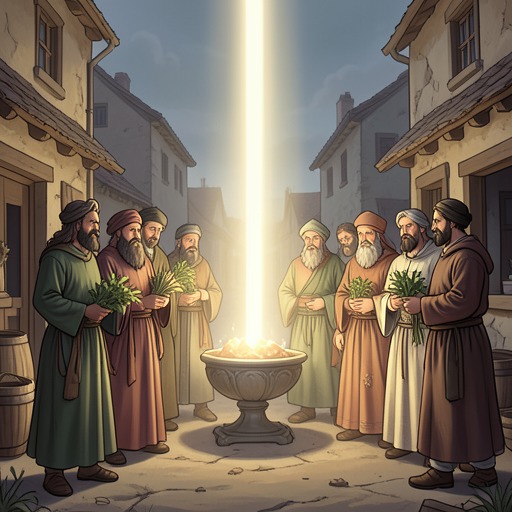
How to Change Your MindEntheogen names a psychoactive substance understood to generate or facilitate a spiritual experience. Coined in the 1970s to distinguish longstanding spiritual and ceremonial uses from the recreational associations that gathered around psychedelics in the 1960s, the term also carries a claim about interpretation: these substances can be understood as part of religious practice, but the label does not by itself establish what a particular community believes or does.
Meaning and Origins
The term derives from Greek and means “generating the divine within.” It was coined by a group of scholars that included R. Gordon Wasson, Richard Evans Schultes, Jonathan Ott, and Carl Ruck. Their word offered a way to describe psychoactive substances in relation to spiritual experience and to rehabilitate their standing by distinguishing ancient religious roles from more recent recreational use.
The book shows the term in action through Jonathan Ott’s lecture at a mushroom conference organized by Paul Stamets and colleagues at Evergreen State College. Ott traced the history of substances understood as Entheogens from the Eleusinian mysteries of ancient Greece through the suppression of Mesoamerican mushroom practices under Spanish rule and into a modern revival associated with R. Gordon Wasson’s account of their survival in Mexico. The term thus joins a history of ritual practice to a history of its suppression and renewed public attention.
A Sacred Practice and Its Changing Uses
The history behind the term is not a single, unchanging story of worship. A sixteenth-century account by the Spanish missionary Bernardino de Sahagún describes Aztec participants eating mushrooms before dawn, then dancing, singing, weeping, sitting in contemplation, or experiencing visions. The account presents varied responses within a shared religious observance rather than one uniform experience.
Spanish authorities treated these practices as a threat to the Church’s authority. Missionaries denounced the mushrooms as the flesh of a rival deity; Native people were interrogated, mushroom stones were destroyed, and the Inquisition brought charges involving peyote and psilocybin. In this setting, the phrase “flesh of the gods” signaled a conflict over access to the divine. The Christian Eucharist depended on church ritual and priestly mediation, while the mushroom sacrament was understood to give the person who consumed it direct access to visions of another realm. Entheogen therefore names not only a kind of experience but, in this historical account, a challenge to institutional control over religious experience.
Yet the book also cautions against treating that older sacramental history as a complete description of later practice. When R. Gordon Wasson went to Huautla de Jiménez in 1955, María Sabina’s community had become Catholic, and mushrooms were used for healing and divination, including efforts to locate missing people or important objects. Wasson knew of these practical purposes; he gained access to a ceremony by saying he was concerned about his son’s well-being. He nevertheless presented the experience through his prior theory about mushrooms and religion, framing the ceremony as a form of Holy Communion. The contrast exposes a limit of the term’s spiritual emphasis: a broad category can illuminate religious meaning while obscuring the specific purposes practitioners themselves describe.
The Name and the Observer
Wasson interpreted his own experience as support for the idea that psychoactive mushrooms had profoundly shaped the origins of religious thought. The book sets that argument beside the narrower, historically situated uses María Sabina described. Her account emphasized that mushrooms were taken to help the sick, not simply to seek God. The distinction is not between a spiritual and a nonspiritual practice so much as between different accounts of what the practice is for—and whose account becomes authoritative.
Wasson’s article in Life magazine helped bring mushroom experiences to a mass audience; he also discussed the subject on television, supplied mushrooms for other published accounts, and held ceremonies in his Manhattan apartment. The spread of his story made the spiritual interpretation influential, even as the book questions how fully it represented Mazatec practice. Entheogen can therefore work as a corrective to the idea that psychedelics are only recreational, while still requiring care: the label cannot substitute for attention to local history, healing, divination, or the difference between a community’s practice and an outsider’s theory.
Modern Uses and Responsibilities
The word also appears in contemporary guide culture, where spiritual experience is treated as a valued possibility that can be approached through several methods, including meditation, breathwork, fasting, and psychoactive substances. A draft charter for guides describes these experiences through ideas such as unitive and nondual consciousness and calls the substances potent spiritual catalysts. Its framing places Entheogen within a wider pursuit of profound experience rather than making drug use the sole route to it.
That spiritual framing comes with practical obligations. Guidance documents address preparation, intention, risks, frightening experiences, and post-session integration; an ethical code emphasizes informed consent, confidentiality, participant safety, and protection from a guide’s self-promotion or financial exclusion. The book presents such rules as a cultural vessel for powerful and potentially misused substances. In this setting, Entheogen names a possible spiritual catalyst, not a guarantee of insight or a replacement for responsible practice.
The term’s reach is visible even in the rooms where guides work: one guide’s shrine included a photograph of María Sabina alongside objects from other traditions. For the narrator, this kind of mixture first looked like an indiscriminate collection of religious symbols, but came to express a syncretic outlook that seeks a shared mystical core across traditions. That contemporary use echoes the term’s promise while preserving its central tension: experiences may be described as access to a common spiritual reality, but their meanings remain shaped by particular people, practices, and histories.